• Home
  • About Rog
  • Coaching
  • Testimonials
  • Blog
  • Contact

Rog Law Fitness - The Art of Sexification

The Art of Sexification

Redefining Normal

May 16, 2011 by Roger Lawson II 11 Comments

Most people regain all of the weight that they fought so hard to lose during their diet.

It’s more commonplace to eat at a restaurant, swing by a drive-through or eat something pre-packaged & convenient than it is to cook a meal at home from scratch.

Over 66% of adults in the U.S. are either overweight or obese.

This is normal.

If you want to join this segment of the population, they’re more than happy to welcome you with open arms – all applications are accepted instantly, no questions asked.

Then there are “the others”.

These people lose the weight and keep it off.

This group carves out the time to cook their own food on a consistent basis and make movement a permanent part of their lifestyle.

This isn’t normal, and members of this group are constantly under siege.

Why are you always eating like that?

Why do you spend so much time working out?

Why don’t you just live a little?

(Read: Why do you silently make me feel bad about the choices that I’m making?)

I’m not here to tell you which group to join – that choice is yours alone to make – but I will tell you this: one group has a much higher chance of achieving their goals, maintaining their results, and changing their lives for the better, while the other group is destined to forever spin their wheels in the mud of life, constantly giving in to every urge that they have, looking for something outside of themselves as the solution.

If you’re happy with your results then who am I to tell you to do otherwise? If on the other hand you have that hunger for more, but currently find yourself apart of the “normal” crowd, then the best thing that you can do is redefine what normal is.

Photo Credit: Ebruli
Guest Post: 10 Reasons You’re NOT Making Progress In The Gym

May 9, 2011 by Roger Lawson II 5 Comments

Sexification Note: Today’s meaty post is brought to you by Jordan Syatt, an ambitious young man who I’m sure you’re going to be hearing a lot from over the next few years within the fitness industry – hope you’re ready to take some notes.

—-

I have an issue. Actually I have a lot of issues, but that is neither here nor there. For some reason this one in particular has really started to get under my skin. Every day I get questions from family, friends, clients, Macedonian princesses, and other people of the sort (O.K. I lied about the princesses) asking me to explain why they’re not making progress in the gym.

The funny thing is every suggestion I make is apparently wrong. According to almost everybody their training is perfect, their diet is on point, and everything in between is absolutely stellar. What gives?

Well I hate to break it to you, but if you were doing everything perfectly than you wouldn’t be having this problem to begin with. More likely than not, you’re doing several, if not many things to keep you from making significant progress.

If you’re tired of making little to no improvement in the gym then check your ego at the door and take a gander at the list below. When you’re finished, set some time aside to reevaluate your current training and lifestyle habits to see if anything needs a change. Be honest with yourself. There’s no room for an oversized ego during this process. Consider the things you may or may not be doing that are preventing you from making the best gains possible, and come up with a plan outlining the changes that you need to make in order to succeed.

Oh one more thing…if you’re satisfied with making little to no progress then you need not read any further.

The List

1. You Don’t Have A Goal

However obvious this one may seem, I’m prepared to wager that most of you haven’t outlined a legitimate goal to center your training routine around; the key word here being “legitimate.” If you’re goal is something akin to “be healthy”, “lose weight” or “get stronger” then you need to dig deeper and think about specifics.

The key to a successful training program is creating an achievable and explicit goal. Anyone can lose weight or get stronger, but how many people can get to 6% body fat or increase their 1rep max deadlift by 100lbs?

By creating a specific goal you can customize any training program to get you there as quickly and efficiently as possible. This brings us to number 2 on the list….

2. You Don’t Have A Plan

I can’t tell you how much it kills me every time I see a guy go from one exercise to the next with no rhyme or reason behind any of his choices, other than that particular muscle isn’t sore and/or the exercise looks pretty damn fun. (In all fairness, bosu balls provide a great platform for party tricks).

I can’t possibly stress enough the value of a training program and its importance in making consistent progress in the gym. Let’s pretend that your goal (recall number 1 on this list) is buried treasure, ok? If we’re equating your goal to buried treasure than your training program is the treasure map; logically speaking, without the map there is absolutely no way you’re going to find the treasure. I mean think about…even Jack Sparrow needs a map. 2nd grade story time analogies aside, a training program is a prerequisite to being successful in the gym.

Make a training program that is designed specifically for you and your goal. Stick with it and follow it exactly as outlined until you get what you want. Repeat this process over and over again and reap the benefits of success.

3. Your Diet Doesn’t Match Your Training

This is when things start to get a little bit tricky. Without going into too much detail, depending on your personal situation and goal you need to either choose a diet that works with your training routine, or choose a training routine that works with your diet.

For example, if you’re an athlete with a fixed training schedule (let’s say it’s the off season and you have practice 6 days/week) than it only makes sense for you to modify your diet based on your training routine.

On the other hand, if you have very strict nutritional guidelines (i.e. large calorie deficit in order to facilitate fat loss) than you’re going to have to modify your training program to suit your diet.

Regardless of the situation, if you’re diet isn’t conducive to your training then you will never progress. Period.

4. You’re Not Doing The Most Productive Movements

This one is pretty straightforward. Depending on your goal there are certain movements that absolutely must be a priority in order to make progress. Generally speaking there are a group of exercises, or variations of them, which should be emphasized in every training program. These movements are compound or multi-joint movements and without a doubt provide the most bang for your buck. They are:

– Conventional Squat and Squat variations (Front Squat, Goblet Squat, Box Squat)

– Conventional Bench Press and Bench Press variations (D-Bell Bench Press, Incline Bench Press, Floor Press)

– Conventional Deadlift and Deadlift variations (Sumo Deadlift, Trap-bar Deadlift, Romanian Deadlift)

– Chinup and Chinup variations (Weighted Chins, Close Grip Chins, Pullups)

There are certainly other moves that have their place in every training program, but if you are, or have been neglecting any of the above movements, I highly recommend programming them into your routine.

5. You’re Not Warming Up

Plain and simple, if you’re not warming up before you train than you’re not training smart.

I can’t express how important a warm-up is in relation to success. Granted, different goals call for different training routines which require different warm-ups, but I have yet see a training regimen which does not necessitate some form of a pre-training stimulus.

I’m not going to take the time here to outline all of the benefits of a well executed warm-up, but suffice to say that getting the right muscles firing before you train can be the difference between a debilitating injury and setting a personal record.

Fewer injuries + more training time = greater progress.

At the very least make sure to incorporate the following into your warm-up:

– Myofacial release (foam rolling)

– Hip flexor work (leg swings, rear leg elevated static lunges)

– Scapular retraction/rotator cuff work (behind the neck pull-downs, band internal/external rotation)

– Glute activation work (butt bridges and variations)

6. Your Ego Is Too Big

As Henry Rollins wisely wrote in The Iron, “Most injuries involving the iron come from ego. I once spent a few weeks lifting weight that my body wasn’t ready for and spent a few months not lifting anything heavier than a fork. Try to lift what you’re not prepared to and the iron will teach you a little lesson in restraint and self-control.”

The weight room is no place for an ego. Ego’s breed poor form and lead to injury. Learn to love the iron and the hard work it takes in order to progress.

In the end you’ll be rewarded.

7. Your Form Sucks

You wanna know what really grinds my gears, (yes I love Family Guy)? Watching people who have no concept of what a good repetition looks like. It could be in regard to chin-ups, Bench Press, Squatting, or unilateral supine hip extensions on a physio ball; honestly I don’t care what the move is, but if you’re using shitty form then I want to hurt you.

This actually ties in really well with having too big of an ego. A lot of times people will use more weight and compensate by reducing their range of motion. Other people legitimately just don’t know what good form looks like, but considering you’re reading this I’m assuming you aren’t one of these people.

Among other things, poor form will inevitably lead to injury simply because performing an exercise incorrectly involves your body training a movement pattern that it wasn’t designed to do. This is why when people tell me “Jordan doing squats hurts my knees!!!” I respond with “No. Not doing squats hurts your knees. If you were squatting then your knees would be fine.”

Use proper form, stay healthier for longer, and make more progress. BAM!

8. You’re Not Adding Weight

When people ask me why they’re not making progress in the gym, one of the first things I ask them is what their 3-5 rep max’s are in the Squat, Bench, and Deadlift, or the respective variations. From here the response is either “I don’t know” or they give me concrete numbers (which are usually 20-50lbs heavier than their actual max’s, but that’s beside the point).

My next question to the people who actually have justifiable numbers for each lift is “How often do you try lifting heavier weight?” The usual response to this includes a scrunched up face filled with a look of utter confusion and ends with them saying something along the lines of “Well I’m not strong enough to go heavier yet.”

Let me explain something, if you’re not attempting to lift heavier weight than you will never get stronger. Period!

More weight = more strength and More strength = more progress.

9. You’re Not Recovering

No matter what your goal is or what your training program entails there are always rest periods. Whether the rest period is a couple of hours or a couple of days is irrelevant to the point I’m trying to make. Regardless of the frequency or length of your rest days, they are crucially important for your recovery and continued progress in the gym.

It doesn’t matter if you’re a powerlifter, a marathon runner, or a rodeo clown; if you’re training hard then a certain amount of recovery is absolutely necessary to ensure your body is ready to go hard when the time comes. Don’t judge…rodeo clowns have intense training programs, or at least I’d assume they do.

10. You’re Scared

I’ll be the first to admit that training can be scary and for a lot of different reasons. For some people there is a fear of getting under several hundred pounds of weight; for others it’s a fear of failure. Regardless of your fear or the deeper reason behind it all, learning to embrace your fear may be the best thing you can do to ensure you improve in your training.

Everyone has fears. No one is completely void of fear and each person has to deal with it on one level or another. However, the difference between those who make progress and those who don’t is the ability to recognize the fear without allowing it to take over their being.

Don’t let fear beat you. Feel it. Embrace the fear. Let it completely fill you. Only when you have fully acknowledged the fear and its presence inside you can you be free of it. To ignore the fear and run from it is to let it win. If you can accept the fear for what it is…an emotion, and continue to work towards your goals, then you will overcome it; you will beat it.

Beat fear. Make progress.

Summing Up

Before this article comes to an end, let us take a moment to recap 10 reasons you may be failing to make progress in the gym, shall we?

  1. You Don’t Have A Goal
  2. You Don’t Have A Plan
  3. Your Diet Doesn’t Match Your Training
  4. You’re Not Doing The Most Productive Movements
  5. You’re Not Warming Up
  6. Your Ego Is Too Big
  7. Your Form Sucks
  8. You’re Not Adding Weight
  9. You’re Not Recovering
  10. You’re Scared

I hope that each of you who read this can now take one step back in order to make 10 leaps forward. To be honest, that’s all training really is: breaking things down just to build them right back up, but even better than before.

Photo Credit: Ivan Walsh

Stop Trying To Keep Up With The Joneses

May 4, 2011 by Roger Lawson II 20 Comments

Once upon a time, I was a relatively strong dude. I bench pressed and chin-upped over 300lbs, front squatted over 400lbs and deadlifted over 500lbs – life was good (and here’s some proof because this is the internet, after all):

http://www.youtube.com/watch?v=EeFbA4KQ08E

http://www.youtube.com/watch?v=SyGgCCo7vaE

These feats all occurred while I was lifting at Cressey Sports Performance for the majority of my training sessions, and while the programming was fantastic, I really attribute getting this strong to the amazing training environment that they foster there. When lifts like these are the norm among staff and clients, you quickly find yourself trying to keep up. These were Joneses of my lifting career and I constantly worked to keep up with them, loving every minute of it.

Then I got hired at a local gym and started lifting alone; I got weaker, much weaker – and it was the best thing that could have happened to me.

Nowadays? I legitimately have no idea where my lifts are. Maybe 50% less. Maybe more.

What gives?

I can only speak from my experience, but I feel that this may resonate with a lot of you: the goals that I was working towards weren’t my own, and I wasn’t having any fun pursuing them.

I’ll use someone I spoke with recently as an example.

This man has been in the iron game for a long time – longer than I’ve been alive. He’s a bench press junkie and if it were legally acceptable to marry the barbell, he would. Over the last few years though, he’s experienced a sharp decline in his strength and is constantly in pain. After hearing him talk about how much it hurts to bench, I asked him if he even liked doing.

His answer? Nope. Too painful.

Yet he persists, despite it not being in his best interest.

If he doesn’t like doing it AND it causes him pain, why does he do it?

This makes me wonder how many people out there are doing exercises that they hate and are chasing goals that they don’t even remotely want to accomplish, in some cases just to impress others or keep up with the Joneses.

I’ll be brutally honest and say that before this epiphany, the only reason I wanted to be super strong was so that I could be a part of the cool club, and so that I could boast a high number if anyone asked how much I lifted it.

After getting away from the crowd and examining my own reasons and motivations for lifting, I was able to discover what my true goals in the gym were. Ladies and gentlemen, I’m a simple man with simple needs. I want to be healthy, not feel like dookie, and give my wife a nice booty to look at.

Bench pressing 350lbs? That’s cool to watch, but I don’t care to work towards that, because it isn’t necessary for my individual goals.

If I like it, I do it. If I don’t, I won’t.

This is the mantra that I live by.

This whole working out and training thing is ideally something that you’re going to be doing for the rest of your life, so you had better like what you’re doing to a certain degree. Doing something just because some guru says that it’s absolutely necessary, even if you hate it, won’t do you a lick of good in the long run. This doesn’t apply to just lifting, but life as well.

You know, some people say life is short and that you could get hit by a bus at any moment and that you have to live each day like it’s your last. Bullshit. Life is long. You’re probably not gonna get hit by a bus. And you’re gonna have to live with the choices you make for the next fifty years.
– Chris Rock

Life is too short to fill it with things that you don’t enjoy, things you have to convince yourself to do it. That’s like working for a shitty boss to stands over your shoulder telling you constantly do, with you both knowing good-and-well that it’s not gonna happen.

Except in this case, the shitty boss is your mind – trippy!

Follow the Joneses for too long and you will one day find yourself at the end of a road only to realize that it lead you to a place that wasn’t of your own choosing.

That’s how some end up working a job that they hate to pay for the expensive gadgets and luxuries that help distract them from the fact that their one beautiful life is out of their control.

The great thing about goals is that no matter how goofy, wild or against the grain they may same to others, they are uniquely yours and yours alone.

You do not need permission. Begin now.

If you think you do, and for some reason you’re looking at me to give it to you, then here it is: you have permission. Begin now.

I invite you to look at the road you’re on and ask yourself some questions:

Are your goals your goals?

Is this where you want to go?

Photo Credit: Allan Sanders

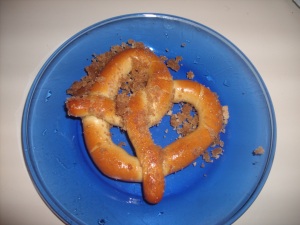
8 Nights With Leigh Peele: Cinnamon Sweet Pretzel Treat

April 27, 2011 by Roger Lawson II 2 Comments

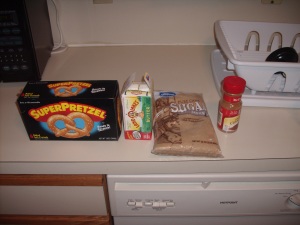
Ingredients:

1 frozen soft pretzel (64g or 1 pretzel is 160-170 calories. I used Superpretzel)
1/8 teaspoon ground cinnamon or to taste
1 tablespoon sugar
1 tsp light “butter” (Smart Balance Light is an example)

Directions:

1. Bake the pretzel according to the package, omitting any salt. (4 minutes at 400 F for this one)

2. Mix together cinnamon and sugar in a shallow bowl.

3. Brush melted “butter” on both sides of the pretzel then sprinkle both sides of the pretzel with cinnamon sugar. Serve immediately

Sexification Tip – To lower the calories even more, you can replace the sugar with a low calorie sweetener (1 tablespoon of sugar is 48 calories, so make sure to adjust the calories accordingly).

Yields 1 serving

1 serving: 224 calories
5 grams protein
3 grams fat
45 grams carbohydrate
1 gram fiber

Impressions:

The Rog Mouth only devours food that is delicious. I know that there are some people out there who make the argument that you shouldn’t be overly concerned with the taste of what you eat, and to those folks I only have one thing to say:

http://youtu.be/cScJZqKpMq4

Moving on.

Prior to this, I hadn’t had an official pretzel in over a decade, and my only experience with them recently was the gargantuan calorie bomb Cinnabon sponsored pretzel at my local movie theater, but that thing is in a league of its own so it can’t possibly count.

I’m a bit of a butter purist, so when I went to the grocery store and saw that this Smart Balance stuff had only about 1/2 (4.5g per tbsp) the fat as regular butter (11g per tbsp), I knew deep in my heart and soul that it just wouldn’t do, so I used half a tablespoon of butter for this recipe, which comes out to be around the same fat content wise.

I melted the butter in the microwave for about 20 seconds and then poured it over the finished pretzel, but the best thing is that even after rolling both sides of the pretzel around the butter and the sugar, there was still a fair amount of it on the bottom of the cooking pan which saves some calories.

In the end though, I’m glad I went with the real deal Holyfield butter wise, because the taste just can’t be beat and the pretzel turned out to be more delicious than expected. This is a great option for a refeed or post workout treat, especially if you keep the fats low by not using a full serving of butter/butter substitute. As a cinnamon addict, the only downside of this is that the likelihood of me eating the remaining 5 pretzels that came in the box within seconds after posting this review is very, very high.

Ok, who the hell am I trying to kid here, I’m eating another one right now and you can’t stop me, bwahahaha!

This recipe was found in Leigh Peele’s Quick & Easy cookbook which can be purchased here. It also features another 20+ recipes if you’re looking to make a minimal time investment towards maximum mouth pleasure. Pow!

Affiliate note: If you purchase any of her cookbooks by clicking the links on this page, I’ll get a small portion of the sale, but this in no way biases my review. I’ll never promote something on this site that I haven’t used personally or that I don’t think will be a great benefit to you all. That is my promise to you, and if you ever see me slipping on it PLEASE be sure cover me with honey and then proceed to fill my apartment with several rabid bears, because I’d deserve it.

How to Rock at Goal Setting

April 25, 2011 by Roger Lawson II 14 Comments

Sexification Note: This article of mine was originally published in Alan Aragon’s Research Review, but after receiving several e-mails about goal setting I felt that it would help a lot more people if I also posted it here.

Author Geoffrey Albert once said that “The most important thing about goals is having one.” This is clearly not the case. The world is overflowing with an abundance of goals, and if you need visual confirmation of this fact, just visit your local gym on January 1st and prepare to be amazed by the massive army of fitness warriors who have arrived on the field of battle. Many come armed with the latest 30 day workout program from their favorite magazine, while others just wing it and hope for the best. No matter how they’ve arrived at this point, the one common bond that links them all together is a goal that spurred them into action.

Just like all great battles however, the casualty rate is high. So why is it that after just a few weeks the number of gym goers actively pursuing their goal experience such a huge drop off? After all, they had a goal, right? Yes, but what they were sorely lacking – and what a large majority of successful people have – was a plan, and a goal without a plan is and will always be just a dream.

While a plan is important, a realistic plan will exponentially increase the likelihood of your success, and borrowing a few concepts Edwin Locke, a pioneer of goal-setting theory, can aid you in creating your own plan. In his book entitled A Theory of Goal Setting and Task Performance, Locke and his colleague Dr. Gary Latham outlined 5 key principles that must be in place in order to motivate us to succeed in the pursuit of our goals:

Clarity – If it is worth doing it is worth doing right the first time, but before we can do it right, we must clearly define what it is. Locke’s research brought to light the notion that the more clearly defined an objective is, the better the chances are of it actually being achieved. For instance, someone who simply wants to “get jacked” has a more ambiguous goal than someone who wants to “increase their front squat by 40lbs in 8 months while maintaining their current body fat levels.” The latter has an exact destination that they are heading towards, and when 4 10lb plates (or however you want to do the math) have been added to that original weight, the goal has been reached; the former however does not. When will his jacktitude quotient be met – 20, 40, or even 100 lbs later? Don’t hamstring yourself from the start by not giving yourself a clear target to shoot for.

Challenge – We must stretch ourselves outside of our comfort zones in order to grow as individuals, and this concept is also critical in setting ones plan for success. The less challenging a goal is, the less excited we are about achieving it. The less excited we are about achieving it, the less likely we are to even bother pursuing it. One tip that I learned from financial guru Dave Ramsey is the importance of starting with the easiest goals first. While the goal may not be exceedingly difficult, the importance of building momentum from the completion of smaller tasks cannot be underestimated. For instance, if your goal is to lose 15 lbs in 16 weeks, that initial weight that is lost during the first few weeks of dieting will serve as a sign that you can do it, and as a lesson to reflect on when the rate of loss slows down. By doing so, you will become more confident in your ability to succeed, which will carry over with you when you begin to tackle more challenging goals.

Commitment – This is where most people tend to fall off the wagon, down the hill and off the side of a cliff. If there is anything that I’ve learned from being surrounded by athletes from all walks of life it is this – effort and attitude trump all. You can have the best training program or business plan in the world, but if you lack pursuit, then you should expect it to show in your results. I would put my money on the person who has the worst training program known to man, but is willing to try their hardest every day.

Religious studies instructor and strength coach Dan John came up with a brilliantly effective and simple way for anyone to assess ones commitment. Simply look at your goals, then look at your behavior and ask yourself one question – do your behaviors match your goals? It’s very easy to say that you want to have an eye-turning physique, but if you’re a 120lb person who spends all nights partying and subsists on energy drinks andgraham crackers, then its time to change either your behaviors or your goals.

Feedback – Just imagine how many satellite launch failures would have occurred if it weren’t for the self-regulating inertial guidance system installed within the rocket. This system is responsible for making on the fly adjustments mid-flight to ensure that the satellite is placed in the exact orbit necessary for it not to come crashing back to Earth, or flying off into space. We as humans have this same system inside of us, but the problem is that we rarely use it.

Successful people do not just create a plan and follow it blindly; they are constantly re-evaluating it based on their results. If the plan they’ve come up with is taking them in the direction that they want to go in, then they just keep on chugging along. In the event that they do come across a snag in the road, they simply make the minor adjustments necessary to keep moving forward. Sadly, we’ve all seen examples of the person who completely demolishes their plan at the smallest sign of stagnation – or even when it hasn’t occurred at all! One week they’re doing total body training, and then the next week they’ve moved onto HIT, and before 30 days have passed they’ve booked a flight to Russia in order to train with self proclaimed kettlebell masters, all the while not getting an inch closer to their original goal. Don’t be that person. If you came across a road block while on a trip across country, would you turn around, drive all the way home, and then pick a different route? A complete overhaul is rarely necessary, so get in the habit of making small adjustments by using outcome-based decision making and you will be in a much better position to achieve what you desire.

Task Complexity — As an elite mountaineer with the accomplishment of reaching the summit of all 14 of the world’s eight-thousanders (mountains more than 8,000 feet above sea level) under his belt, Ed Viesturs knows a little something about goal achievement. While reading his book No Shortcuts to the Top, I couldn’t help but take note of his most repeated mantra – “Getting to the top is optional, but getting down is mandatory.” Some become so fixated on reaching the summit that in their mind the battle is won once they make it to the top, when in fact it has just begun. It is of paramount importance to make sure that you know what you’re up against when you decide to tackle a difficult task. While this isn’t always possible, the more informed you are, the better decisions you can make. The point of having a plan is make sure that you manage your resources appropriately in order to reach your destination, not to go out in a blaze of glory before you even get there. Mount Everest is the burial ground of many people who pushed to the top despite the fact that they lacked the necessary mental and physical resources. Let us not make this same mistake.

The greatest variable in achieving our goals is time. While taking our sweet time has its own consequences, going too fast or giving up too soon because we don’t have a realistic grasp on how long it will take is a much larger hazard. If you develop a plan that fails to acknowledge passion, planning, sacrifice, struggle, commitment and consistency as an integral part of the process, then it’s time hit the drawing board again. There is an entry fee for anything worth achieving in life, and as the great blues guitarist B.B King once said, “You have to pay the cost to be the boss.” By applying Locke’s principles of goal setting to your own endeavors, success will not be a matter of if, but when.

What goals do YOU have? What are you doing to get there? Is there anything that I can do to help? Let me know in the comment section!

Photo Credit: cameronparkins

« Previous Page
Next Page »

"What you can expect from Roger as a trainer is his visions the big picture. He doesn't see life, fitness, or Sexification through a narrow view. He takes the time to get to know his clients inside and out. He understands that the victory to their journey is one in more ways than just the workout. However, when it comes to that workout, he has the chops. He is the true epitome of Sexification."

— LEIGH PEELE

Click Here To Learn More About Consults

GET HOT SEXIFICATION TIPS FOR A BETTER BODY, A BETTER MIND AND A BETTER LIFE

Enter your email below and I'll give you the Universe's Sexiest Newsletter. You'll get free tips, delivered hot to your inbox, that you can use to make every single day sexier.

You'll get no spam. That'd be lame.

Stalk Me

  • Facebook
  • Twitter
  • YouTube

Copyright © 2026 · Magazine Pro Theme on Genesis Framework · WordPress · Log in